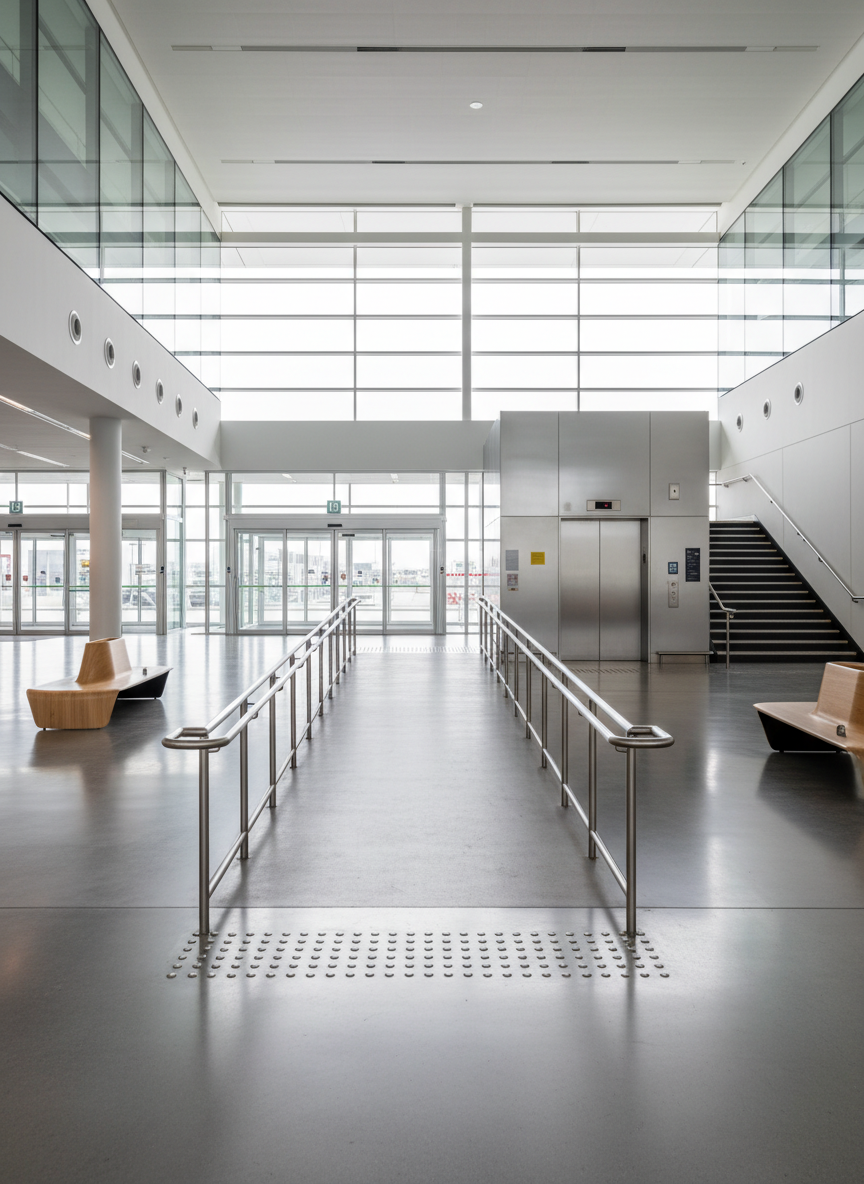
A sleek, modern airport departures hall rendered in photographic realism, focusing on a wide, gently sloping ramp with stainless steel railings and smooth, non-glare flooring. Discreet tactile paving guides the way toward automatic glass doors. In the midground, a clearly marked elevator with large illuminated buttons sits beside a short but steep staircase, illustrating different mobility options without showing people. Soft, diffused daylight filters through high clerestory windows, casting gentle reflections on polished surfaces. Shot from a slightly elevated, wide-angle perspective that emphasizes clear pathways, turning radii, and resting spots like low benches. The mood is calm, organized, and professional, hinting at both potential challenges and thoughtful accessibility design for travelers with mobility or balance issues.

Travel Accessibly

Real-world snapshots of traveling with Parkinson’s—honest, practical notes on what worked, what didn’t, and how each place truly felt.

Why I Document Accessible Journeys

I travel with Parkinson’s, recording each destination’s ramps, stairs, crowds, and surprises so others can plan with realistic expectations, not glossy promises.

A cobblestone European old town square at golden hour, photographed with meticulous realism, highlighting the contrast between beauty and mobility challenge. The foreground shows uneven, glossy stones with deep grooves and subtle puddles, captured in sharp focus to emphasize trip hazards and difficulty for wheels or shuffling gaits. In the background, gently blurred historic buildings with pastel facades, step-up café terraces, and a single narrow ramp tucked to the side illustrate limited but present access solutions. Warm side lighting creates long shadows that exaggerate texture. Shot at low angle along the ground plane to show the path a mobility device might take, creating a contemplative, slightly wary mood that balances wanderlust with practical awareness.
A compact but thoughtfully designed hotel room, shown in clean photographic detail, focusing on accessibility features for a traveler with Parkinson’s. The scene includes a bed at transfer-friendly height with contrasting linens, sturdy grab rails subtly integrated into the headboard and beside the bed, and a clear, wide path to the bathroom. The bathroom door is open, revealing a roll-in shower with a fold-down bench, handheld showerhead, and horizontal and vertical grab bars against matte, non-slip tiles. Warm, even ceiling lighting eliminates harsh shadows, creating a reassuring, restful mood. Shot at eye level with a medium-wide lens to capture the full layout and turning space, while a neatly folded suitcase stand and labeled light switches hint at practical takeaways for evaluating future accommodations.
An urban sidewalk scene in a busy city center, captured in realistic photographic style, emphasizing accessibility obstacles and workarounds without any people present. The foreground features a cracked, sloping curb cut with pooled water and a metal utility cover, clearly illustrating potential balance and traction issues for someone with mobility challenges. To one side, a smooth alternative ramp built into a modern glass-fronted building provides a safer route, marked by a subtle tactile strip and brushed steel handrail. Overcast daylight produces soft, shadowless lighting that highlights surface textures without glare. Framed using the rule of thirds from a slightly off-center, eye-level perspective, the image guides the viewer’s eye from the hazardous curb toward the better-designed entry, conveying an informative, problem-solving atmosphere.
A scenic coastal boardwalk at sunset, rendered as high-resolution photographic realism, spotlighting accessible travel done well. The main subject is a wide, level wooden pathway with closely spaced planks, bordered on one side by a sturdy handrail and on the other by low, evenly spaced benches that offer frequent resting spots. Discreet symbols etched into the rail indicate accessible routes and beach wheelchairs stored nearby in a small, open shed. Golden hour light bathes the scene, creating warm highlights on the wood grain and a gentle glow on the calm ocean beyond. Shot from a gentle diagonal angle that leads the eye forward along the path, the composition suggests relaxed, confident exploration, emphasizing positive accessibility experiences and practical design ideas for similar destinations.
A compact metro station platform in a major city, captured with photographic clarity, focusing on wayfinding and access for travelers with Parkinson’s. The foreground shows a bright yellow tactile strip with raised domes, contrasting against dark, matte tile flooring. Nearby, a clearly visible elevator shaft with glass walls and illuminated indicators stands beside a steep escalator, illustrating choices without human figures. Overhead LED signage is represented abstractly through glowing rectangles, avoiding text but indicating real-time information. Cool, even artificial lighting creates a crisp, alert mood with minimal shadow. The composition uses leading lines from the track edge and ceiling panels, drawing the viewer’s eye toward the elevator as the safest, most stable option, subtly educating about what to look for when navigating unfamiliar transit systems.
A tranquil forest trail in a national park, depicted in lifelike photographic style, comparing a rugged path against an adapted accessible route. In the foreground, a smooth, compacted gravel trail with gentle grade, intermittent wooden edging, and occasional pull-out bays for resting winds into the trees. Slightly off to the side, a steeper dirt path with roots and rocks is visible, hinting at the challenge some visitors face. Soft, dappled morning light filters through the canopy, creating a peaceful yet alert atmosphere where surface details and gradients remain clear. Shot from a low, forward-looking angle, the composition emphasizes horizon visibility, handrail-free sections, and the stability of the accessible path, offering visual cues for evaluating outdoor trails when traveling with balance or fatigue concerns.

Stories

I’m a senior traveler exploring the world with Parkinson’s, alongside my partner Becky. We share honest stories, mobility tips, and accessible itineraries to inspire continued adventures, even as our bodies change. I’ve fallen many times, but one thing we should always do is get up and start again. We must never give up on pursuing our dreams.

I was diagnosed with Parkinson’s in 2020, which prompted me to leave my role as an AP Region Lean Senior Manager at Amazon AWS. After that, I set off on extensive travels across Asia, Europe, and South America. It’s only in the past two years, starting in 2025, that I began exploring the world with a wheelchair. This website will be my space to share the stories and adventures from those journeys.

Updates

New accessibility posts straight to your inbox.